Why the mosquitoes in your yard bite in the middle of the day
If you have given up on the garden at two in the afternoon rather than at sunset, there is a reason for it.
September 1, 2026 · 4 min read
Most people grow up with a simple rule about mosquitoes. They come out at dusk, they bother you for an hour or two after sunset, and if you go inside when the light goes you mostly avoid them. It is a rule that works in a lot of the country. It does not work here.
The predominant mosquito across northern Alabama is the Asian Tiger Mosquito, and it bites aggressively through the middle of the day. Not exclusively, and not gently. Households across Decatur, Madison and Athens describe the same pattern to us every summer: the garden becomes unusable at lunchtime, not at nightfall, and the family quietly stops going out there at all.
Why the old rule stopped working
The dusk rule describes species that rest through the heat and feed in the cooler margins of the day. The Asian Tiger Mosquito does not follow that schedule. It is a daytime feeder, it is persistent, and it is happy working in shade rather than waiting for the whole sky to cool down.
That shifts where the problem actually lives. A mosquito that feeds at dusk is a problem of timing, and you can dodge it by changing when you sit outside. A mosquito that feeds all day is a problem of place. It lives at the shaded, humid edges of your property and it comes out to the parts you use. You cannot out wait it, which is why so many people conclude the garden is simply lost.
The edges matter more than the lawn
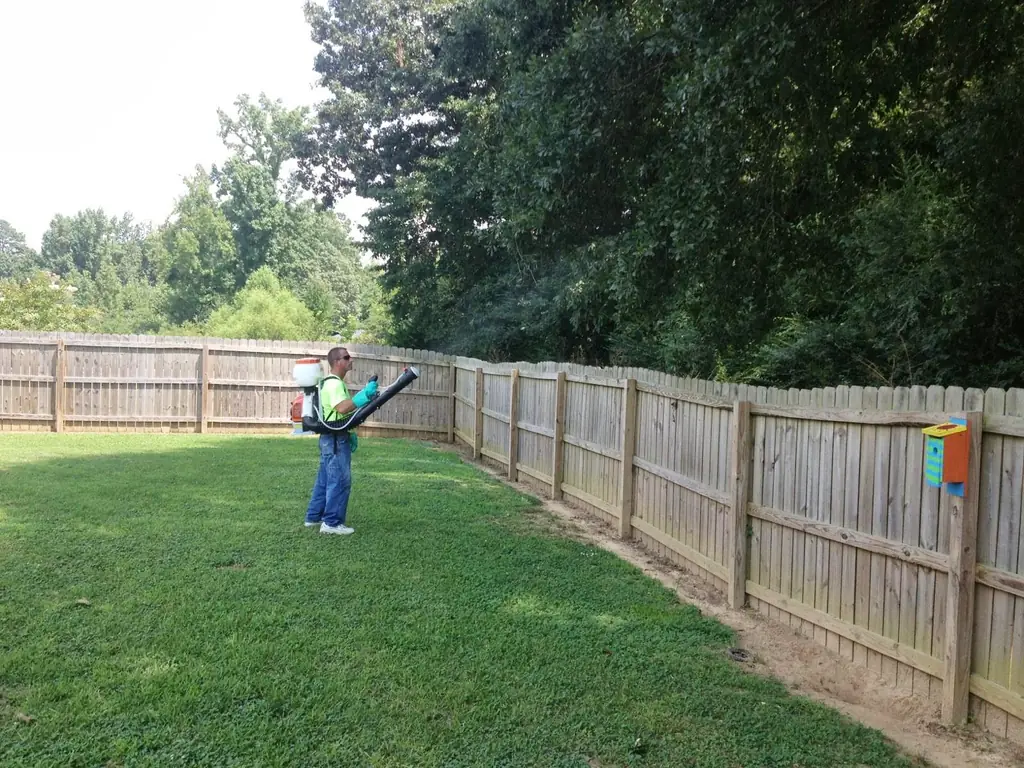
Because these mosquitoes rest in shade and humidity rather than in open sun, the middle of a mown lawn is rarely where they live. They live in the boundary. That means the fence line, the growth behind it, the treeline, the planting beds tight against the house, the shaded strip under the eaves, and any long grass at the margins where nothing gets walked on.
This is why fogging the open lawn feels productive and achieves so little. You are treating the room the mosquitoes visit rather than the room they live in. Anything that is going to change the situation for more than an afternoon has to be worked into the harborage at the edges.
- Fence lines and the growth immediately behind them
- Treeline and any dense, shaded planting at the boundary
- Beds against the wall of the house, where moisture holds after rain
- The shaded strip under eaves and overhangs
- Long grass at margins that never gets cut or walked through
There is a health argument, not only a comfort one
It is easy to file mosquitoes under nuisance. In this region the City of Huntsville Vector Control Division links local mosquitoes to West Nile Virus, Eastern equine encephalitis, St. Louis encephalitis and La Crosse encephalitis. That is not a reason to panic about a bite, and we are not going to pretend it is. It is a reason to treat a mosquito population as something worth actually reducing rather than swatting at.
A daytime biting species raises the exposure simply by being awake when your household is. Children playing after school, someone doing the beds at the weekend, a dog out in the middle of the day. The hours when a dusk feeder would be dormant are the hours this one is working.
What actually changes the situation
Three things, in order of how much difference they make. First, remove or treat the breeding sites, because a population that keeps hatching on your property will always outpace anything you spray at the adults. Second, treat the harborage at the edges rather than the open lawn. Third, do both again before the effect wears off rather than after you notice it has.
That last point is the one people underestimate. A treatment that has worn off is not a treatment that is fading gently. The population rebuilds, and if the gap between visits is long enough you spend part of every cycle back where you started. This is the whole reason mosquito control is sold as a program with an interval rather than as a single visit.
A reasonable expectation
Nobody can promise a garden with no insects in it, and you should be wary of anyone who does. What is realistic is a garden you use again. The most common thing customers tell us is not that they never see a mosquito. It is that the deck went back into service, the children play outside again, and a barbecue stopped being something you talk yourself out of.
If your garden has quietly gone out of use at the wrong time of day, the species is a large part of the explanation, and the fix starts at the boundary rather than in the middle of the lawn.
Superior Mosquito Defense — (256) 795-3368
Call (256) 795-3368More articles
The teaspoon problem: where mosquitoes actually breed in your yard
Almost every garden has more standing water in it than the owner thinks, and most of it is not the pond.
What a 21 to 25 day mosquito barrier actually does between visits
The number on the program is not marketing. It is roughly how long the treatment keeps doing its job in Alabama heat.